My Journey Through the Forza Universe: Ranking Every Forza Game From the Pinnacle of Racing Simulation to Its Casual Cousins
As a longtime racing enthusiast, I've spent countless hours behind the virtual wheel of Forza games. The series, which began in 2005, has defined the simulation racing genre on Xbox consoles for me. Its core promise—delivering an authentic racing experience in terms of performance, handling, and speed—has been a constant throughout its evolution. A key feature that has always impressed me is the Drivatar system. These AI-driven avatars learn from and adapt to my driving style, creating races that feel uniquely challenging and personal. Over the years, this system has been refined, continually raising the bar for what I expect from a racing simulator. The Forza family has grown to include two main sub-series and a few experimental spinoffs, each offering a distinct flavor of automotive excitement. Today, as I look back on the entire catalog up to 2026, I want to share my personal ranking and reflections on every Forza title I've experienced.
14. Forza Street
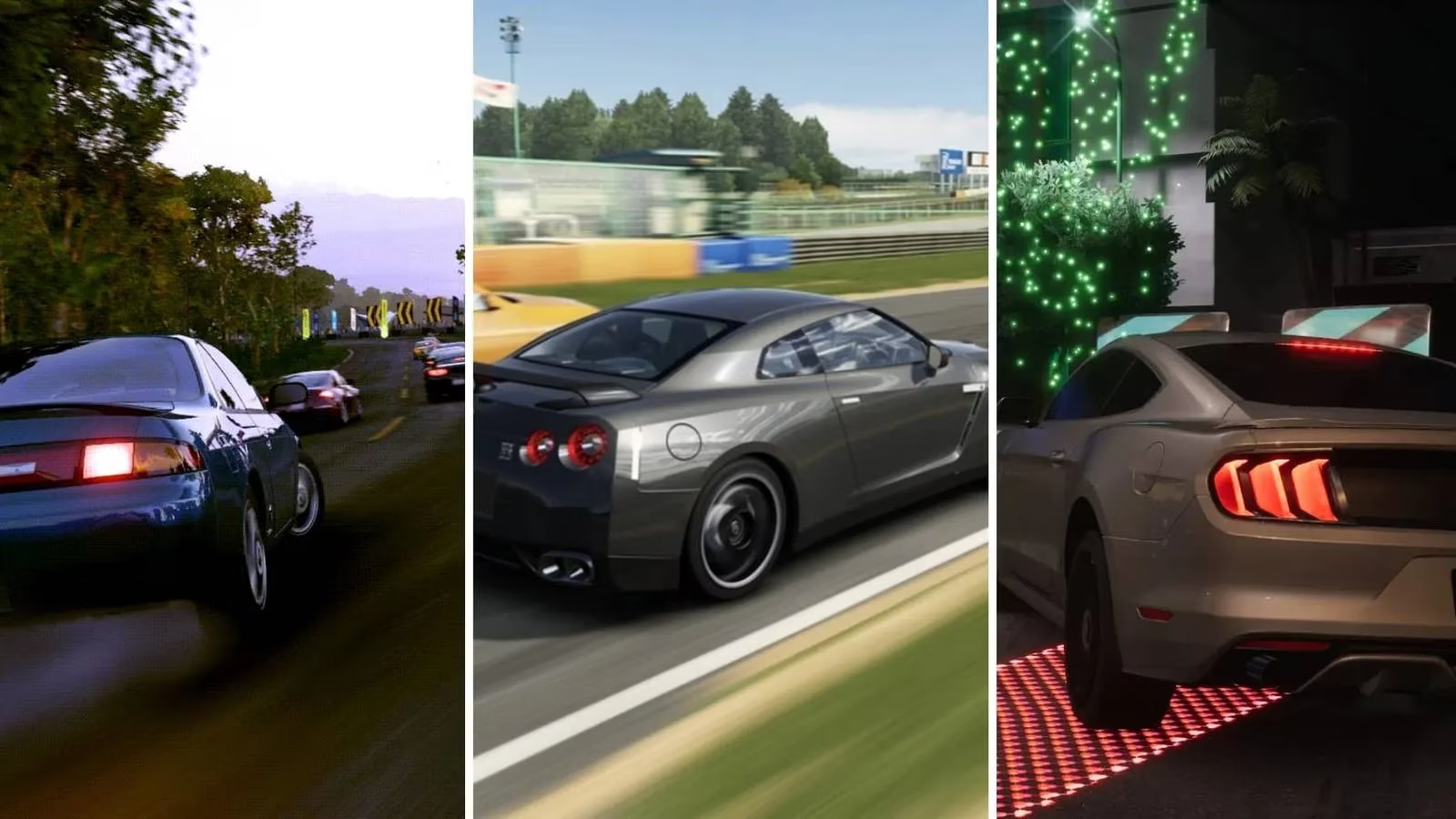
My journey starts with a title that feels like a distant, somewhat forgotten memory. Forza Street began its life as Miami Street before adopting the Forza name. This free-to-play game for Windows 10 offered a radically simplified experience. The steering was completely automatic, leaving me to control only acceleration and braking. While the graphics were decent, the gameplay loop became tedious very quickly. I found it hard to muster excitement for new events or locations, and the overall experience lacked the depth I craved. It's perhaps no surprise that the servers were shut down back in April 2022. For me, it's a curious footnote in the Forza legacy, one that few players, including myself, truly remember fondly.
13. Forza Horizon 2 Presents Fast & Furious
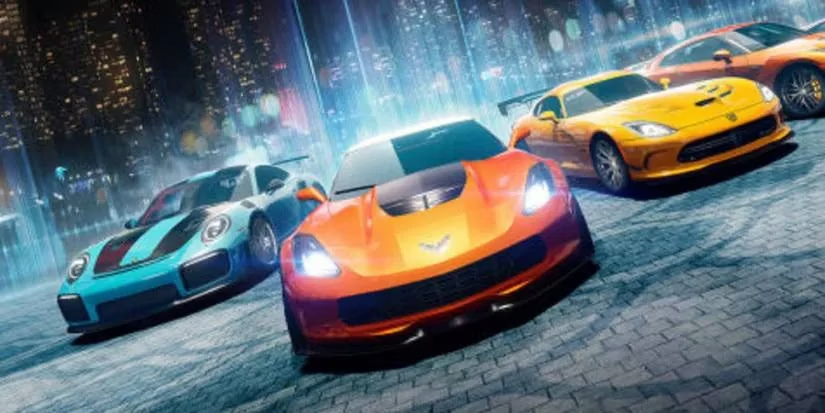
Next is a fun but fleeting crossover. Forza Horizon 2 Presents Fast & Furious was a standalone expansion that plunged me into the world of the film franchise. The career mode had me working for the crew, tasked with collecting ten iconic cars from Furious 7. It was a blast to interact with characters like Tej Parker (voiced by Ludacris, just like in the movies). This title was pure fan service, and while I enjoyed the high-octane vibe, it felt more like a well-made piece of promotional content than a substantial Forza game. Its availability was limited, and it was delisted from sale in October 2018, making it a brief, neon-soaked detour in the series' history.
12. Forza Motorsport 4
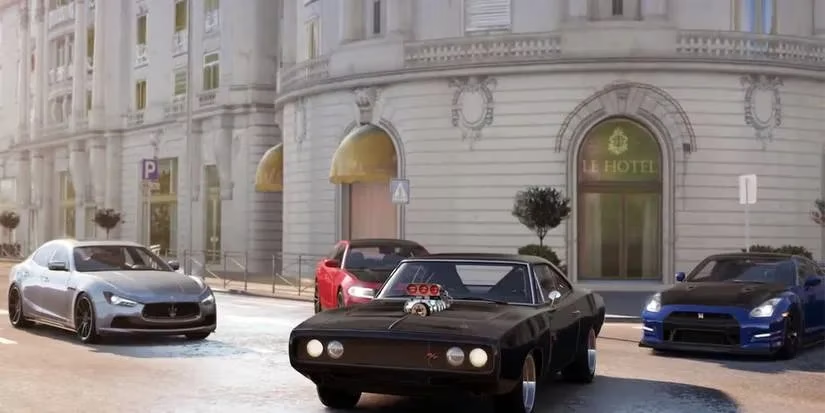
Forza Motorsport 4 arrived with great promise, heavily promoted alongside the Xbox Kinect sensor. The idea of using my body to control the game was intriguing—turning my head to look around the cockpit or holding my arms out to steer. In practice, however, the Kinect features were frustratingly unpredictable. The camera often failed to pick up my movements accurately, making those modes more of a novelty than a viable way to play. When I reverted to the traditional controller, I found the same superb, polished simulation experience Forza is known for. Yet, at the time, it felt somewhat like an incremental upgrade from its predecessor. It remained the premier racing sim of its generation, but the Kinect integration, for me, was more of a distracting gimmick than a revolutionary feature.
11. Forza Motorsport 2
The first sequel, Forza Motorsport 2, built solidly upon the foundation of the original. Released in 2007, it was universally praised for its exceptional vehicle handling and deep customization options. From my perspective, the core gameplay didn't change dramatically, but the sheer volume of content was impressive. One standout improvement was the granular damage settings. I loved having the choice between purely cosmetic scratches and dents or a brutal simulation where a bad crash could render my car useless. This title didn't reinvent the wheel, but it refined the formula and crucially set the stage for the incredible depth that would define the series' future.
10. Forza Motorsport 3
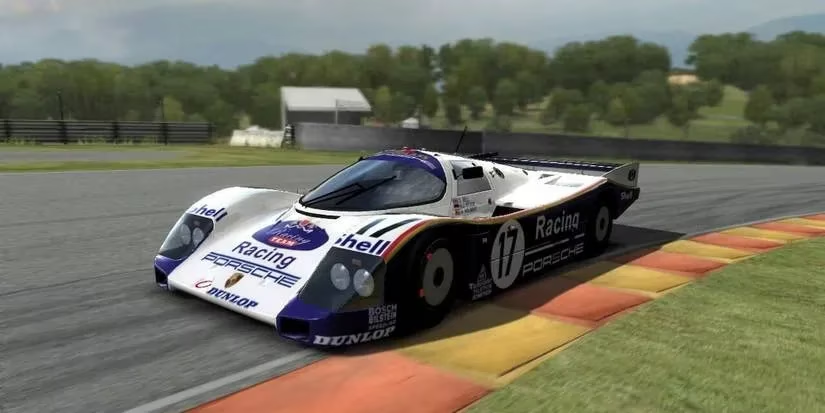
With Forza Motorsport 3, I felt the series take a massive leap forward. The jump in scale was breathtaking. The Ultimate Collection edition boasted over 500 cars and more than 100 tracks, offering an almost overwhelming amount of content. The gameplay expanded excitingly with the formal introduction of drifting, drag racing, and even dramatic rollover physics. The single-player career mode was incredibly rich, with hundreds of events that allowed me to deeply tune my cars for specific challenges. Where it fell slightly short for me was in multiplayer. Race sizes were reduced, and the lack of custom public lobbies limited the social, community-driven racing I had begun to crave. It was a phenomenal solo experience that left me wanting more ways to connect with others.
9. The Original Forza Horizon
This is where the magic of open-world racing truly began for me. What started as a spinoff, Forza Horizon, quickly proved it was something special. It transplanted the impeccable handling of the Motorsport games into a vast, explorable open world centered around the fictional Horizon Festival in Colorado. Moving away from sterile circuits to the winding highways and dusty backroads was a revelation. The sense of freedom was unparalleled. I could spend hours just driving, discovering hidden areas, or engaging in impromptu street races. Any minor flaws were utterly eclipsed by the game's sheer joy and replayability. It wasn't just a racing game; it was a celebration of car culture and open-road adventure.
8. Forza Motorsport (2005)
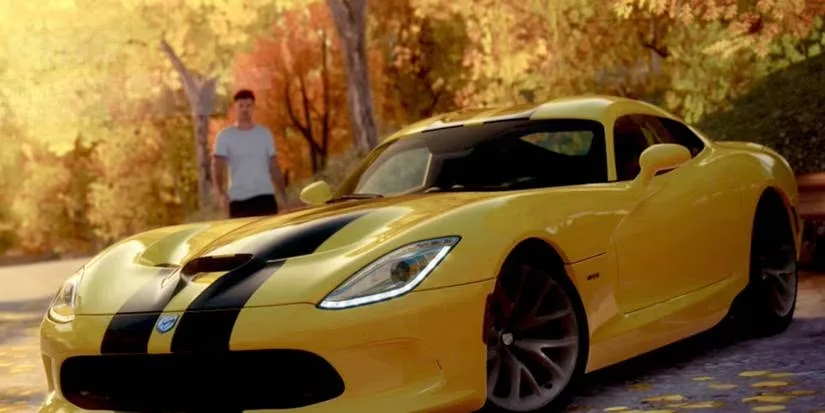
Everything started here. The original Forza Motorsport launched in 2005 and instantly set a new standard for realism on consoles. With over 200 cars and a mix of real and fictional tracks, it offered a depth I hadn't experienced before. The level of control was astounding—I could tweak nearly every visual and performance aspect of my car. It was rightly hailed as the most realistic console racer of its time. My main recollection, however, is its steep learning curve. Mastering the nuanced physics and handling required serious dedication. It was a challenging, sometimes punishing, but ultimately rewarding simulator that established the DNA for everything that followed.
7. Forza Motorsport 5
As a launch title for the Xbox One, Forza Motorsport 5 had a lot to prove, and for me, it succeeded in bridging a gap. It was the first Motorsport game that felt designed for both hardcore sim enthusiasts and casual players. I could dive into a serious career mode with all assists off, or I could jump into an arcade-style race for a quick, fun session with friends. While the car and track list felt a bit lean at launch, the game's technical achievements were stunning. The AI, powered by the evolving Drivatar system, was fiercely competitive, and the visuals were a generational leap. Every race felt consequential, and it truly showcased the power of the new console.
6. Forza Horizon 2
Forza Horizon 2 made it abundantly clear that the Horizon series was here to stay—and that it might just be the future. Trading the Colorado Rockies for the sun-drenched coasts of Southern France and Northern Italy, the game's world was triple the size of the original and breathtakingly beautiful. The sense of limitless freedom was intoxicating. I could explore for hours, race on almost any road, and experience the world's first dynamic weather and full day-night cycle in a Forza game. It perfected the open-world formula, offering an experience that was accessible, endlessly enjoyable, and visually spectacular. For many, including myself, this was the moment Horizon became the flagship experience.
5. Forza Horizon 3
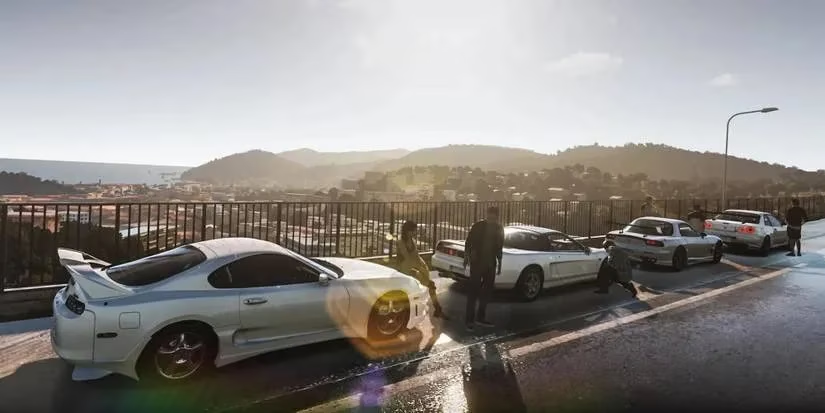
If Horizon 2 perfected the formula, Forza Horizon 3 super-sized it. Set in a fictionalized, diverse version of Australia, the map was twice as large as its predecessor. The big twist was a change in role: I was no longer just a participant in the Horizon Festival; I was its manager. My goal was to race, perform stunts, and complete challenges to earn fans in different regions, unlocking new festival sites and events. This meta-game added a wonderful layer of progression and ownership. The map was a playground of stunning biomes—from lush rainforests to arid deserts and a vibrant city. The car list was massive, and the sense of being at the center of a global automotive party was unmatched. It represented the peak of open-world racing ambition for its time.
A Legacy of Innovation and Excitement
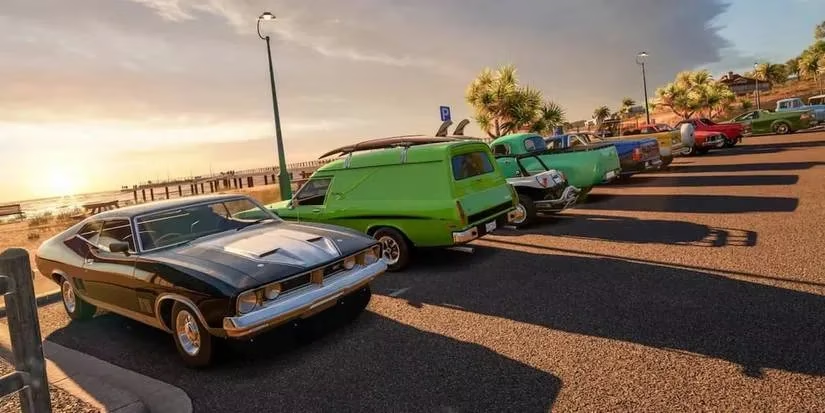
Reflecting on this journey from 2005 to the present day, I'm struck by how the Forza series has consistently pushed boundaries. The core Motorsport lineage has delivered uncompromising simulation, demanding precision and rewarding mastery. The Horizon series, born as a spinoff, evolved into a phenomenon that redefined open-world racing with its emphasis on freedom, exploration, and celebration. Even the less successful entries, like Forza Street or the Fast & Furious crossover, show a willingness to experiment. As of 2026, the legacy continues with new entries building on this incredible foundation. For me, Forza is more than just a game series; it's a decades-long testament to the thrill of speed, the beauty of engineering, and the pure joy of the drive. Whether on a closed circuit or an open road, it has consistently provided the ultimate virtual driving experience.
Data referenced from PEGI helps contextualize how varied Forza’s lineup has become across the “sim-to-arcade” spectrum described above—especially when comparing streamlined, free-to-play experiments like Forza Street with broader festival-driven entries in Horizon and more technical Motorsport releases, where age-rating notes and content descriptors often mirror the series’ shift in tone, accessibility, and feature focus over time.
Discussion