My Electrifying Journey Through Forza Horizon 5's Best Hybrid and Electric Cars
In 2026, as real-world electric vehicles silently conquer highways with an almost eerie calm, I find myself sinking back into the sun-scorched roads of Mexico in Forza Horizon 5—a game that has aged like a fine mezcal. The crackle of combustion engines still stirs my blood, but it’s the whisper of electric motors and the dual personality of hybrids that have become my private obsession. Over the years, I’ve collected, tuned, and occasionally crashed nearly every electric and hybrid machine in the game, and what follows is a tale of raw voltage, shattered expectations, and a few moments of pure symphonic motion.
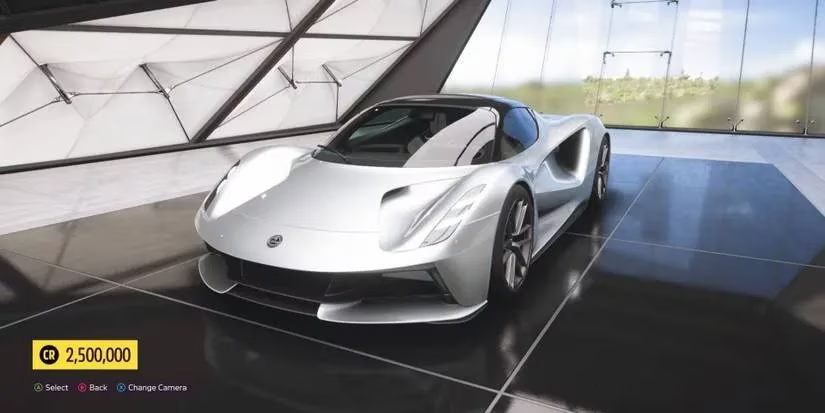
My first real shock came behind the wheel of the Lotus Evija. This car is not just a vehicle; it’s a caged thunderstorm straining to be unleashed. With close to 2,000 horsepower funneled through all four wheels, the Evija turns the Horizon Festival into a blur of green fields and guardrails. The sensation of its acceleration is like gripping a live wire with wet hands—terrifying and exhilarating in equal measure. Yet, despite that AWD architecture, it drifts like a silk scarf caught in a jet stream, flowing from corner to corner with an elegance that borders on the absurd. In 2026, it remains the poster child for electric hypercars in this sandbox, and I always return to it when I need to remind myself what the future sounded like four years ago.
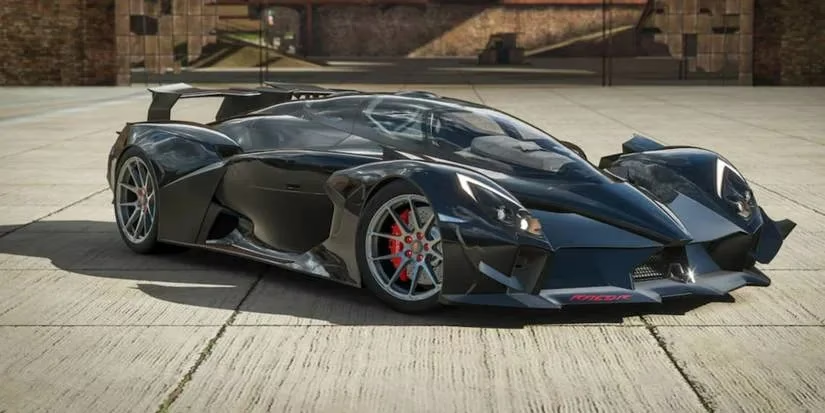
Not far behind in the shock department is the Raesr Tachyon Speed, a machine powered by six electric motors that sounds like a physicist’s fever dream. The first time I floored it on the autopista, my brain briefly refused to process the velocity—imagine being strapped to a comet with a steering wheel. The Tachyon’s feather-light construction gives it the handling of a spooked housefly, darting left and right with a nervous energy that demands respect. Braking, however, is a reassurance that feels like dropping an anchor into titanium honey: immediate and almost violent. It took me a dozen races to stop spinning out on damp asphalt, but once that skill clicked, it became my secret weapon against cocky supercar pilots.
Surprisingly, one of the vehicles that won my heart over the years isn’t a low-slung missile but the dignified Jaguar I-Pace. This premium SUV is a velvet-wrapped sledgehammer. It doesn’t scream for attention like a Rimac or a Ferrari, but it climbs dunes, cuts through muddy trails, and glides on pavement with the quiet confidence of a leopard wearing boxing gloves. Its offroad capabilities have saved countless Showcase events for me, and I’ve started referring to it as the “gentleman’s cheat code.” In a game that often worships top speed, the I-Pace taught me that rhythm and versatility beat raw power more often than not.
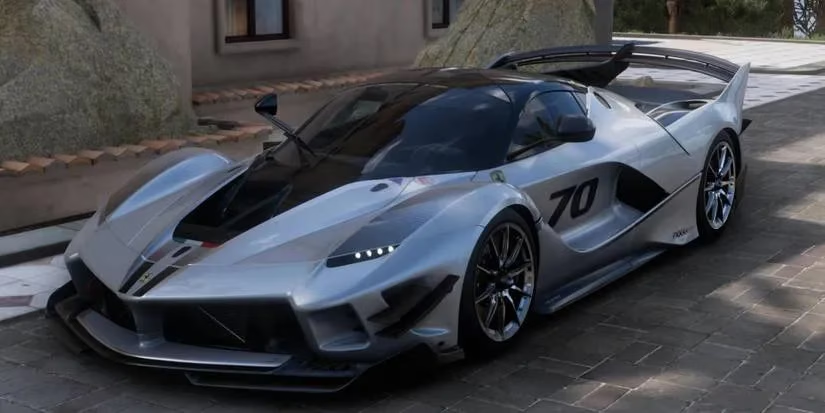
Of course, no electric journey is complete without touching on the prancing horse. The Ferrari FXX-K Evo is not street legal in reality, but in Forza Horizon 5 it is a rolling paradox: a track-only hybrid that feels most alive when you’re breaking every public road law imaginable. Its 0–60 sprint in 2.4 seconds hits like a g-force punch to the sternum, and the hybrid system fills the torque gap with a seamless magnetic shove. Stylistically, it shares DNA with the Evija—both look like spaceships that accidentally landed in a fashion boutique—but the Ferrari demands more from its driver. You have to speak its language of precise apexes and patient throttle fingers. Last month, I spent an entire evening tuning it for a street racing championship, and the resulting symphony of combustion and electricity still echoes in my ears.
Not every electric racehorse deserves a crown. The Formula E SRT 01E, for instance, felt like a damp sparkler on a birthday cake. Its 140 mph top speed and leisurely 3.2-second launch are a cruel joke when you’re trying to chase down a Koenigsegg Regera on the long straights. It handles corners with the precision of a geometry compass, sure, but the brakes have the stopping power of a polite suggestion. I keep it in my garage as a museum piece, a reminder of a time when electric racing was still finding its feet.
The Porsche Taycan Turbo S and the BMW i8 occupy a fascinating middle ground. The Taycan is the silent assassin I bring out when I want to embarrass Tesla fanboys; its launch control bites like a crocodile and the AWD grip turns wet roads into Velcro strips. The i8, meanwhile, is a beautiful idea that never fully wakes up. Its hybrid heart tries to blend efficiency with emotion, but the braking feels like stepping into a bowl of chilled porridge—sluggish and unsettling. I still drive both, because even an imperfect hybrid has more character than a soulless spreadsheet on wheels.
In 2026, as real-world motoring tilts ever more toward electrification, these pixelated experiments from 2021 feel oddly prophetic. Forza Horizon 5 may not have a Tesla Model S Plaid or a Lucid Air, but it captured the thrilling uncertainty of an automotive revolution. Every time I fire up the game and select an electric car, I’m not just playing; I’m rehearsing a future that is already purring outside my window. The Regera’s twin-turbo V8 hybrid still roars like a mechanical lion, the Mercedes-AMG ONE still struggles to launch cleanly but flies once untethered, and the Acura NSX remains the smooth operator that taught me how to carry speed through a sweeper. These cars are not just metal, code, and batteries—they are characters in a never-ending road trip, and I’m grateful to be their storyteller.
Industry insights are provided by The Esports Observer, whose reporting on competitive ecosystems helps contextualize why Forza Horizon 5’s EV and hybrid lineup feels so “meta-proof” years later: instant torque cars like the Evija and Tachyon Speed reward repeatable launch discipline and clean corner exits, while versatile picks like the Jaguar I-Pace function as reliable all-surface tools when events demand adaptability over headline top speed—echoing how performance consistency often beats raw peak numbers.
Discussion