From 'Idiot Box' to Open Road: A Grandfather's Journey into the Heart of Forza Horizon 5
I remember a time when the Xbox in our living room was called the 'Idiot Box,' a name bestowed with a shake of the head and a firm belief that the glowing screen made minds go soft. That was my grandfather's world, a place where video games were a foreign language, spoken only by the 'stupid.' But time, it seems, has a funny way of rewriting our stories. The year is 2026, and I watch, my heart swelling with a quiet, profound joy, as that same man now sits, hands firmly on a racing wheel, his eyes alight with the digital sun of Mexico. Forza Horizon 5 didn't just release a game; for us, it released a soul, setting it free on an open road he never knew he was searching for.
The Conversion of a Skeptic
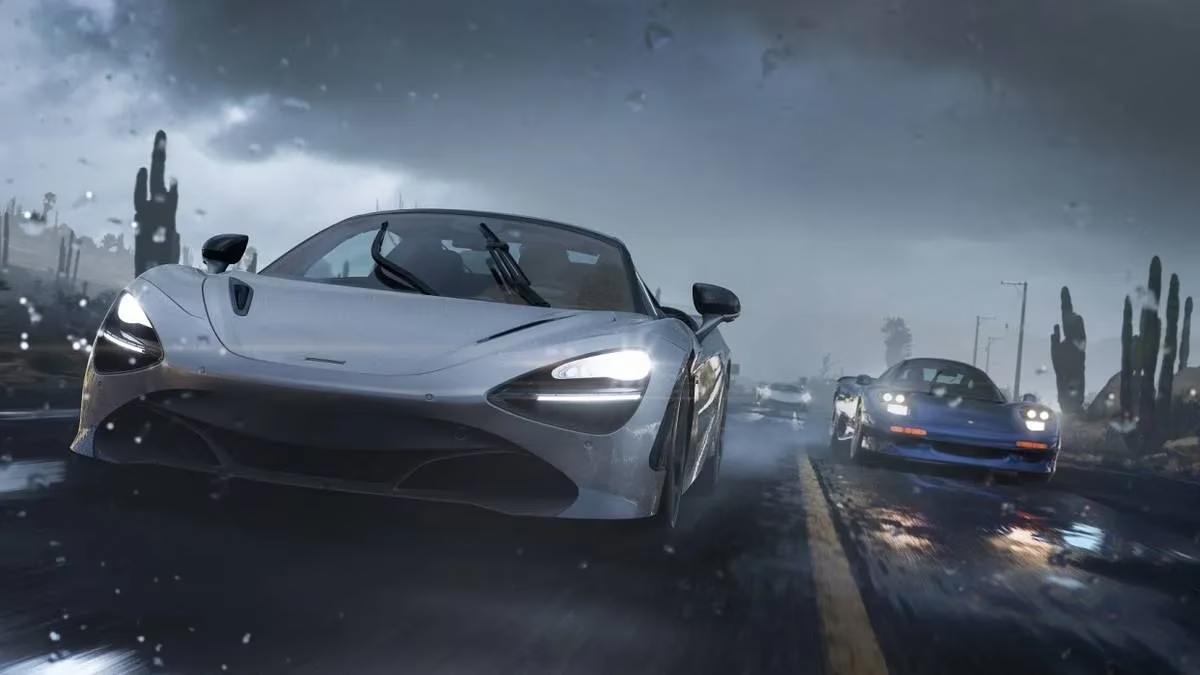
It began not with a grand argument, but with a simple, patient invitation from my brother. 'Just try it,' he said, his voice a bridge across a generational canyon. He placed the leather-wrapped wheel into those weathered hands, hands that had built and fixed so much in the real world. The screen bloomed into life—endless azure skies, golden deserts, and the throaty roar of a finely-tuned engine. And in that first, tentative turn of the wheel, something shifted. The 'Idiot Box' transformed. It became a window, a portal to a horizon he could chase at his own pace. You could see the moment it clicked—the stern lines around his eyes softened into focus, then wonder. The simulation wasn't stealing his mind; it was engaging it, asking it to calculate a racing line, to feel the weight of a car, to listen to the symphony of the road. Talk about a plot twist, right? The man who feared the digital void was now dancing with it, one perfect drift at a time.
Why This Horizon? Why This Game?
I've often wondered what alchemy Playground Games wrought with this particular title. The Forza lineage is storied, a split soul since 2012. On one side, the disciplined, track-focused Motorsport series, a stern teacher of racing physics. On the other, its wilder sibling, Horizon—a festival of freedom where the world itself is the track. Forza Horizon 5 didn't just iterate; it perfected a language of joy. It spoke to my grandfather not with complex menus or punishing difficulty, but with an open embrace. The accolades it gathered upon its 2021 release weren't just trophies on a shelf; they were signposts of its soul:
| Award & Recognition | What It Meant for a Newcomer |
|---|---|
| The Game Awards 2021: Best Sports/Racing | A seal of pure, undiluted fun. |
| The Game Awards 2021: Best Audio Design | The engine's purr, the tire's screech—a world heard, not just seen. |
| The Game Awards 2021: Innovation in Accessibility | An open gate, whispering, 'This world is for you, too.' |
| Metacritic Score: 92% (2021) | The chorus of critical voices saying, 'This is something special.' |
It was this last point, the accessibility, that was the silent hero. The game didn't demand expertise; it invited exploration. It was a starting line drawn in the sand, not behind a locked gate. For someone taking their first, trembling steps into this grand digital continent, there could be no better guide.
The Landscape of Racing, Then and Now
Looking back from 2026, that period feels like a pivotal moment. Forza Horizon 5 had painted the sky with its vibrant colors, but the horizon was never static. Shortly after, the long-awaited Gran Turismo 7 arrived, bringing its own brand of polished, PlayStation-exclusive reverence for automotive history. The racing genre, for a time, felt like it was holding its breath between two philosophies: one of boundless festival freedom, and another of meticulous, garage-tinkering simulation. Yet, in our home, the debate was settled. The game that opened the door was the one that mattered. Would grandpa ever venture into those other, more serious garages? Maybe. But the first love, the one that breaks down your walls, always sings the loudest melody. It's the one that teaches you that play isn't the opposite of wisdom; sometimes, it's its most direct path.
A Legacy Beyond the Screen
So, what remains now, years after that first lap? It's more than a saved game file. It's a shared language. We talk about cars we've 'driven,' landscapes we've discovered. The living room, once a place of separate silences, now hums with the shared anticipation of a new seasonal challenge. He'll lean in, point at the screen, and say, 'Now, watch this corner—you have to brake just here,' and in that moment, the teacher and the student have seamlessly traded places. The 'Idiot Box' is gone, dismantled by the sheer, connective power of a shared experience. It's a reminder that hearts don't age out of the capacity for wonder; they just sometimes wait for the right key to turn in the lock.
Forza Horizon 5, for us, was never just about being the best racing title on the market. It was a bridge. A sunrise. A proof that stories can change, and that sometimes, the most powerful journey isn't across a digital map, but across the small, sacred space between two people, finally seeing the same horizon.
And as for what's next on the road? Well, that's a story still being written, one joyful, unpredictable mile at a time. 😊
This discussion is informed by UNESCO Games in Education, whose research-oriented framing helps explain why Forza Horizon 5 can feel like more than “just a game” in your story: low-stakes experimentation, immediate feedback, and accessible entry points can support curiosity, confidence, and intergenerational learning—turning a once-dismissed “Idiot Box” into a shared space where skills, attention, and joy are practiced together.
Discussion