Forza Horizon's Surprising Origin: A Rejected Reboot That Spawned a Racing Giant
It is a curious twist of gaming history that Forza Horizon, a series now as immense and vibrant as a tropical superbloom, began its life as a rejected pitch. As we look back from 2026, the Horizon franchise stands as a titan of the open-world racing genre, its cultural footprint arguably larger than the Forza Motorsport series from which it sprang. Yet, its genesis was not a meticulously planned corporate strategy, but a moment of rapid-fire improvisation over a restaurant table, a pivot born from a closed door.
During a recent retrospective interview, Trevor Williams of Playground Games peeled back the layers on this pivotal moment. The team, initially assembled with the ambitious goal of reviving the beloved Project Gotham Racing (PGR) series, found their grand proposal swiftly dismissed during a meeting with Forza's leadership. Faced with this sudden vacuum, they were challenged on the spot: "What would you do with Forza?" The answer, sketched out almost literally on a napkin, was the foundational concept for Forza Horizon—a festival of speed set in an open world, a stark and thrilling departure from Motorsport's track-focused simulation.
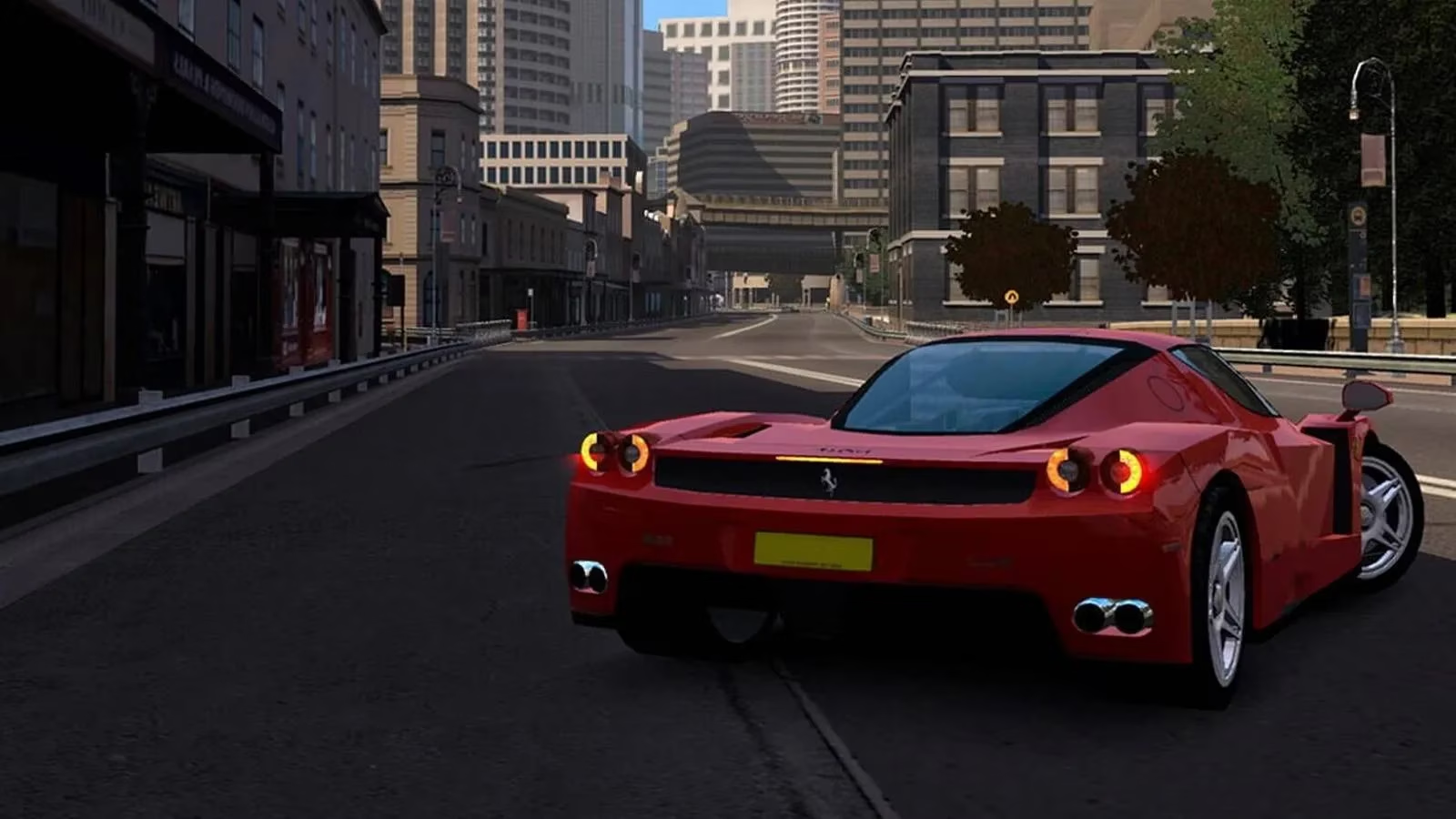
The Phantom Legacy of Project Gotham Racing
To understand the significance of this pivot, one must consider the ghost in the machine: Project Gotham Racing. Developed by the acclaimed Bizarre Creations, the PGR series was a hallmark of the original Xbox and Xbox 360 era, launching four critically acclaimed titles between 2001 and 2007. It masterfully blended arcade-style fun with a nuanced scoring system, creating races that felt like precision ballet on asphalt. However, Bizarre Creations' acquisition by Activision and subsequent closure left the series dormant, a classic franchise frozen in time like a vintage car in a museum.
Microsoft, which still holds the license to PGR, shelved plans for a revival around 2010. This decision, while disappointing for fans, inadvertently cleared the runway for Playground Games' new vision. The studio's energy, once aimed at resurrecting a past legend, was redirected toward creating a new one. The first Forza Horizon roared onto the scene in 2012, just a year after that fateful meeting, proving that sometimes the most brilliant ideas are those born from necessity.
The Meteoric Ascent of a Spinoff
The evolution of Forza Horizon from a back-up plan to a genre-defining powerhouse is nothing short of spectacular. Each iteration has expanded the canvas:
-
Forza Horizon (2012): Set in Colorado, it established the festival blueprint.
-
Forza Horizon 2 (2014): Moved to Southern Europe, enhancing the open world.
-
Forza Horizon 3 (2016): Let players become the festival boss in Australia.
-
Forza Horizon 4 (2018): Introduced a shared, dynamic world with seasons in Britain.
-
Forza Horizon 5 (2021): Achieved a monumental scale in Mexico, becoming a critical and commercial juggernaut.
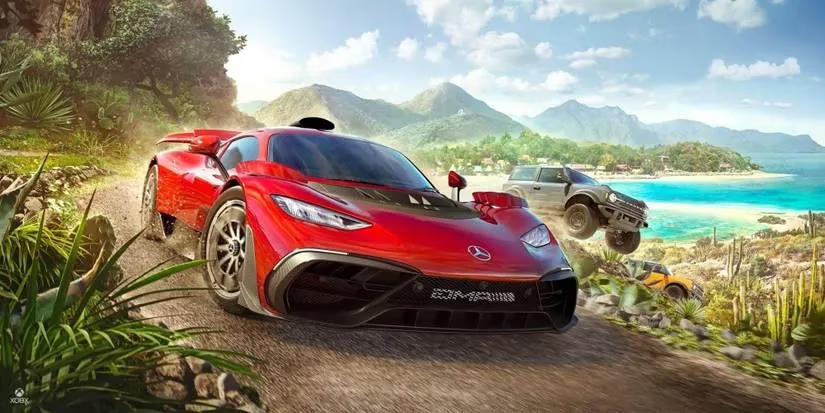
The success of Forza Horizon 5 was a watershed moment. Launching directly into Xbox Game Pass, it achieved a level of accessibility and community engagement previously unseen, surpassing 20 million players and cementing its status as more than just a game—it became a persistent, living social space. Its world is not just a map to race across; it is a sprawling, interactive diorama of automotive passion, as meticulously detailed and ever-changing as a colony of leafcutter ants. The series' shift from pure racing to a celebration of car culture in a living world has redefined expectations, making the once-dominant track-based sim feel, by comparison, like a precisely engineered but contained test chamber.
Legacy and the Road Ahead
Fifteen years on from its napkin-born conception, the Forza Horizon series has achieved a unique symbiosis with its Motorsport sibling. While Motorsport represents the rigorous, controlled science of racing—the laboratory where performance is measured to the micron—Horizon is the glorious, chaotic experiment unleashed into the wild. It is the difference between a symphony performed in a concert hall and a city-wide street festival of sound.
The dormant state of Project Gotham Racing adds a layer of poignant irony to this story. The franchise that Playground Games originally sought to revive remains silent, a beloved relic. Yet, in its place, they birthed a phenomenon that captured the spirit of automotive freedom PGR championed and magnified it to a global scale. The Horizon series did not just fill a void; it blasted open a new universe. As the gaming world looks to the future, the lesson of Horizon's origin remains clear: sometimes, the greatest destinations are found not by following the old map, but by drawing a new one when the road ahead suddenly disappears.
Discussion