Forza Horizon 5 Unleashes Permanent Raytracing: A Visual Revolution in Open-World Racing
In the ever-escalating arms race of graphical fidelity, Playground Games has just detonated a visual megaton bomb in the racing genre. As of 2026, Forza Horizon 5 has shattered its own technical glass ceiling by implementing permanent, full-scale raytracing support during active gameplay, a feature that transforms the sun-drenched vistas of Mexico from a mere digital playground into a shimmering, photorealistic diorama. This is not a subtle tweak; it's a fundamental re-engineering of how light behaves in one of gaming's most celebrated open worlds. Where once raytracing was a party trick confined to the static, curated perfection of Photo Mode, it now flows through every canyon sprint, every dusty festival site dash, and every rain-slicked street race in real-time, turning the entire game world into a dynamic, reflective canvas.
The Technical Alchemy Behind the Shine
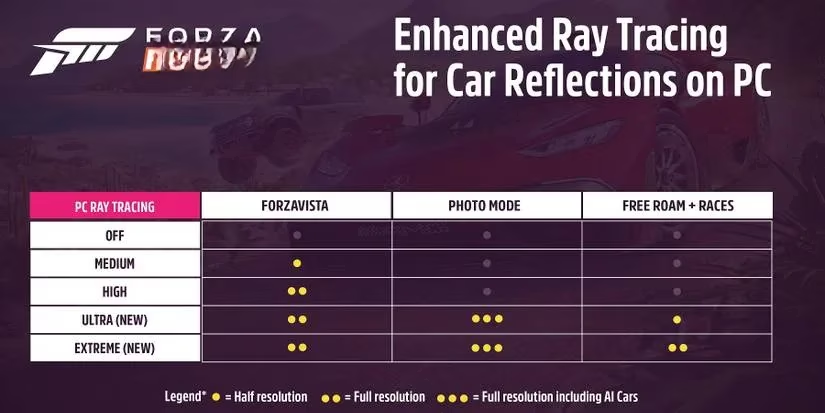
Unlocking this visual sorcery is a feat of engineering that borders on wizardry. Players on high-end PC rigs can now venture into the graphics menu and toggle raytracing to "Ultra" or the newly introduced, borderline-mythical "Extreme" setting. The recommended hardware spec reads like a wishlist for tech enthusiasts: the battle-tested NVIDIA RTX 4080 or the formidable AMD Radeon RX 7900 XTX. However, Playground Games, in a stroke of pragmatic genius, implemented a crucial optimization. During the chaotic ballet of a race or the serene chaos of free roam, only the player's vehicle receives the full, unadulterated raytracing treatment for its reflections. Every other car on the road is rendered using the highly refined, but less computationally hungry, rasterization technique.
This decision is a masterclass in balancing spectacle with performance. Think of it as placing the player's car under a microscopic lens of pure light simulation, while the surrounding traffic exists in a slightly softer, yet still stunningly detailed, focus. It's the difference between a soloist performing under a single, brilliant spotlight and an entire orchestra illuminated by a grand chandelier—both are magnificent, but the focus is deliberately, and effectively, placed. The result? A buttery-smooth frame rate isn't sacrificed on the altar of visual excess. To further sweeten the deal, the update comes bundled with support for the latest upscaling technologies: NVIDIA DLSS 3.5 with Frame Generation and AMD FSR 3.0, which act like digital alchemists, transmuting lost performance back into the experience.
A World Transformed: From Render to Reality
The impact of persistent raytracing is less of an upgrade and more of a transmutation. Mexico is no longer just a backdrop; it becomes a character in its own right, interacting with light in ways previously unimaginable.
-
The Wet Look, Perfected: Post-storm streets are no longer just shiny textures. They become genuine mirrors, perfectly reflecting the distorted, waving forms of palm trees, neon festival signs, and the underbellies of bridges with a liquid, oily authenticity. Driving through Guanajuato at night after a downpour feels like piloting a spaceship through a canal of liquid obsidian and fractured city lights.
-
Metallic Majesty: Car paint jobs, especially on hypercars with complex curves, undergo a revelation. Candy apple reds and chrome finishes don't just look shiny; they actively ingest their surroundings, painting the environment onto their flanks in a constantly shifting, living mural. Your Lamborghini Sian isn't just green; it's a rolling, emerald-hued kaleidoscope of the Mexican sky and landscape.
-
Natural Light, Reborn: Sunlight filtering through the dense canopy of the jungle no longer feels like a pre-baked effect. Each beam becomes a tangible entity, scattering through leaves, casting dappled, moving shadows across the hood of your car, and creating god rays that have volumetric weight and presence. It turns a simple drive into a journey through a cathedral of light and shadow.
This leap was once thought to be the exclusive domain of the more controlled, circuit-based Forza Motorsport. Rendering a few dozen cars on a closed track is one thing; applying that same computationally intensive magic to a living, breathing open world with hundreds of dynamic elements was seen as a bridge too far. Playground Games didn't just cross that bridge; they built a hyperloop under it.
More Than Just Pretty Lights: The Donut Media Legacy
This monumental technical update arrived not in a vacuum, but as the crown jewel of the now-legendary "Donut Media" season. This season was a direct response to community feedback craving more visceral customization, following a previous update that had offered only a modest selection of body kits. The Donut Media season delivered in spades, addressing the hunger for personalization with surgical precision.
The season's haul was nothing short of spectacular:
| Content Type | Specific Additions | Impact |
|---|---|---|
| Wide-Body Kits | 21 classic Rocket Bunny kits | Transformed Japanese tuner icons into pavement-hugging monsters. |
| New Vehicles | A curated list of modern hypercars and retro classics | Expanded garage options with meta-defining performance cars. |
| Visual Customization | New rims, liveries, and bumper options | Allowed for deeper personal expression beyond performance tuning. |
This combination of cutting-edge graphical technology and deep, satisfying customization created a perfect storm. Players weren't just seeing their cars in a new light; they were building those cars to be seen, crafting unique machines that would interact with the revolutionary lighting in personal and spectacular ways. The roar of a Rocket Bunny-kitted Nissan GT-R was now accompanied by the visual symphony of its widened fenders perfectly reflecting the streaking lights of a Horizon Festival main stage—a sensory overload of the highest order.
The New Benchmark
As of 2026, Forza Horizon 5 with permanent raytracing enabled doesn't just lead the pack in open-world racing; it exists in its own stratosphere. It has set a benchmark so high that it casts a long, reflective shadow over the entire genre. The implementation is a testament to intelligent design—knowing where to apply the full force of the technology (the player's experience) and where to use clever, imperceptible optimizations (the surrounding world). It proves that visual fidelity and consistent performance are not mutually exclusive, even in the most demanding virtual environments.
The game has evolved from being one of the best-looking racing games into a genuine tech demo for the future of real-time graphics, all while never forgetting that at its heart, it's about the unbridled joy of driving. The world of Mexico, now seen through the lens of simulated photons, feels more alive, more tangible, and more breathtakingly beautiful than ever before. It’s a place where every sunset paints the world in molten gold, every puddle holds a perfect, inverted universe, and your car is not just a vehicle, but a prism through which the entire digital landscape is filtered and reflected. The bar has not been raised; it has been launched into orbit. 🚗💨✨
Discussion