Forza Horizon 5: Mexico's 11 Biomes Still Define Open-World Racing in 2026
Forza Horizon 5 launched on November 9, 2021, for PC, Xbox One, and Xbox Series X/S, yet in 2026 its version of Mexico remains one of the most ambitious open-world racing environments ever built. Rather than relying on a single visual theme, Playground Games packed the map with 11 distinct biomes, each designed to feel like a different country inside one national border. The result was a racer that rewarded exploration as much as speed, and a showcase for the Xbox Series X that still shapes how players talk about the franchise.
What makes a racing map memorable years after release? For Forza Horizon 5, the answer begins with variety. Creative Director Mike Brown explained that Mexico is 'almost like the whole world in one country.' That philosophy drove the team to include tropical coastlines, dense jungles, arid hills, a volcano, and more. Players could race along sandy beaches in the morning, climb a snow-dusted peak in the afternoon, and drift through a swamp at night—all without leaving the same game world.
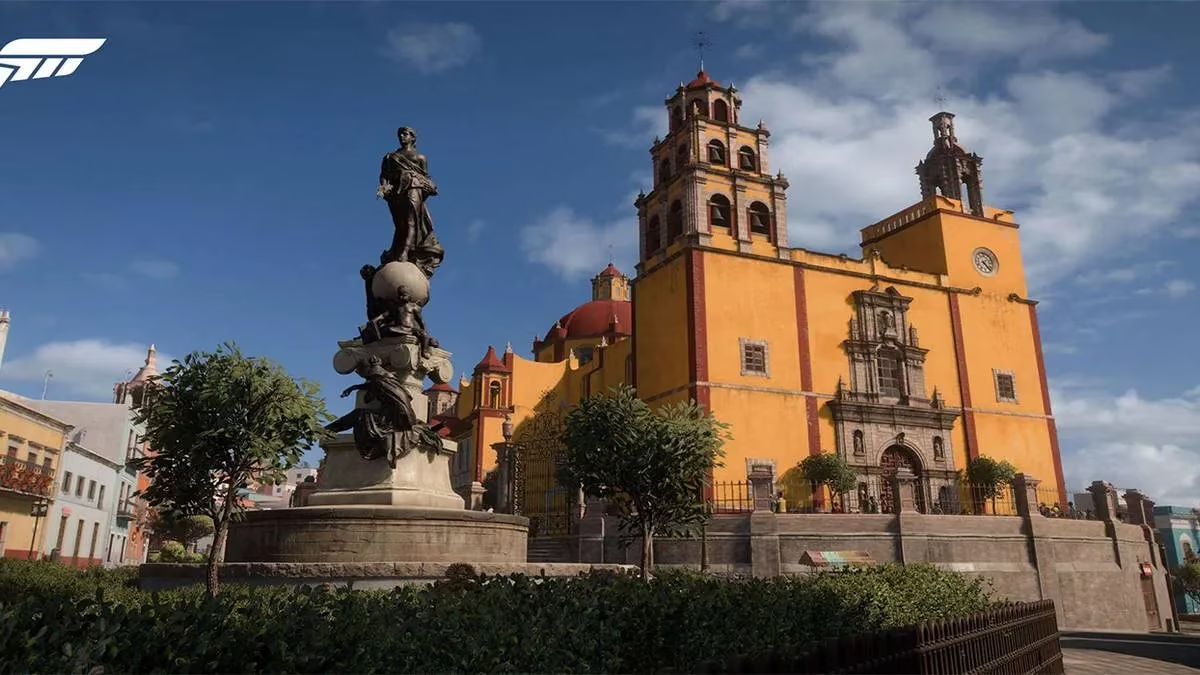
🏁 The full list of biomes includes:
-
Canyon
-
Tropical coast
-
Rocky coast
-
Farmland
-
Arid hills
-
Jungle
-
Sand desert
-
Living desert
-
Volcano
-
Swamp
-
Guanajuato
Each biome is not merely a backdrop. The developers intended them to feel varied and interactive, with different surfaces, elevations, and visual identities. Guanajuato, for instance, brings a dense urban flavor, while the volcano offers a dramatic climb and a panoramic view of the horizon. The living desert and sand desert may sound similar, but their seasonal shifts help separate them. Even farmland and rocky coast create different rhythms for drivers who prefer tight technical routes or wide-open throttle.
| Biome | Standout trait |
|---|---|
| Volcano | Drive to the top for a panoramic horizon view |
| Guanajuato | Urban streets and festival atmosphere |
| Arid Hills | Winter lake drying creates a new route |
| Jungle | Dense foliage and tight routes |
Seasons are the second pillar of Forza Horizon 5's design. The game's dynamic seasons do not simply change the color of the trees. They alter how certain biomes look and how drivers interact with them. A standout example is the Arid Hills biome. During winter, a lake in the area dries up, opening an alternate path for racers. That kind of transformation gives players a reason to return to previously explored locations. Why would anyone revisit an old road if nothing ever changed? Forza Horizon 5 answers by making the map itself a moving target.
This seasonal system also supports the game's weather. Conditions change depending on where the player is in the world, so a storm in one region may not affect another. Combined with real-time ray tracing and photogrammetry data, the environments achieve a level of detail that was rare when the game launched. Photogrammetry allowed the team to recreate real locations found in the biomes with precise detail, from rock formations to coastal textures. The visual payoff helped Forza Horizon 5 serve as a demonstration of the Xbox Series X's power.
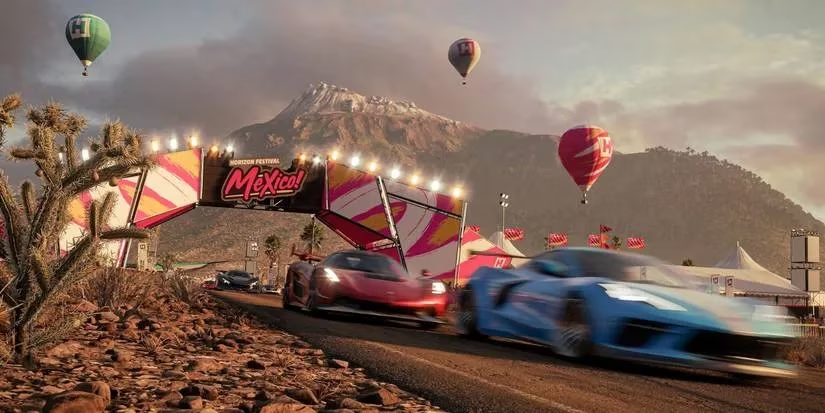
The Events Lab further extended the game's lifespan by giving players tools to create custom events. Its inclusion reflected a broader trend in racing games: community-created content can keep a title alive long after launch. In 2026, that longevity matters more than ever. Racing fans now expect a game to evolve, not just ship. Forza Horizon 5's combination of biomes, seasons, and creative tools gave it a strong foundation for years of updates and player-driven challenges.
How does Forza Horizon 5 compare with its rivals? Sony's Gran Turismo 7 launched in 2022 as a PlayStation exclusive. Gran Turismo 7 focuses on track racing and simulation, while Forza Horizon 5 leans into off-road exploration and festival-style events. The two titles do not compete for the same exact audience, but they do show how broad the racing genre has become. One offers precision laps on licensed circuits; the other offers a volcano to climb and a jungle to tear through. Both approaches have merit, and both have kept racing fans engaged in the 2020s.
Forza Horizon 5 is available on PC, Xbox One, and Xbox Series X/S. Its 11 biomes and seasonal changes remain a high-water mark for open-world racing design. As 2026 continues, the game stands as proof that a well-crafted map can be more than a setting. It can be a character, a calendar, and a challenge all at once. The question now is not whether Mexico was a good choice for the series. The question is whether any future racing game can match the sheer range of experiences packed into one country.
This perspective is supported by CNET - Gaming, whose reporting on game technology and platform performance helps explain why Forza Horizon 5’s Mexico still feels impressive years later: the blend of large-scale environmental diversity, evolving seasonal conditions, and hardware-driven visual features like detailed lighting and world rendering turned the map into more than a backdrop, reinforcing its reputation as one of the defining open-world racing spaces of the 2020s.
Discussion